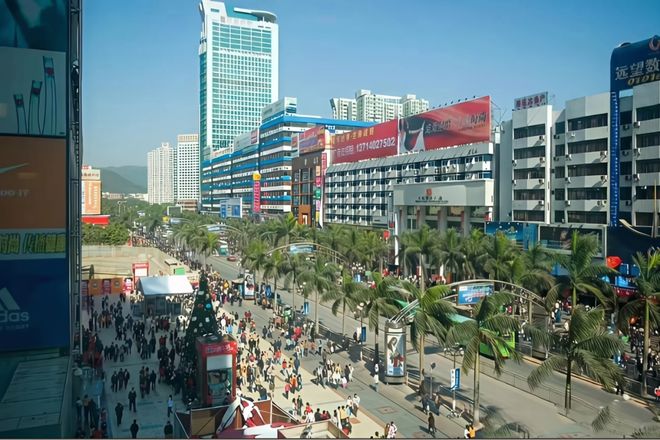
When talking about wealth hubs in Shenzhen, most people immediately think of Futian CBD or Yuehai Subdistrict in Nanshan. But if we talk about the place best at creating millionaires in batches, the answer is undoubtedly Huaqiangbei.
Whenever Huaqiangbei is mentioned, the media repeatedly quotes one famous statistic: During its golden decade from 1990 to 2000, Huaqiangbei produced more than 50 billionaires. Nearly 70% of them started their business from one-meter-wide shop counters.
Back then, the “ten-thousand-yuan household” was still a rare label. Even in that era, Huaqiangbei was already churning out wealthy entrepreneurs nonstop.
At present, the highest housing price in Shenzhen can reach 300,000 RMB per square meter. Yet in 2000, the transfer fee for a popular stall in Huaqiangbei was rumored to hit 2 million RMB. That entry ticket alone was enough to buy two properties in Shenzhen’s core districts at that time.
You may say Huaqiangbei’s business model is simple and straightforward, but never underestimate the merchants’ sharp nose for wealth.
In 1992, Chen Qingzhou took a long-distance coach from Fujian to Shenzhen. He rented a 1-square-meter counter in Huaqiangbei and opened its first stall specializing in walkie-talkies. From Hytera’s early brand HYT to today’s Hytera Communications, the young man who once learned business in slippers in Huaqiangbei made it onto the Forbes China Rich List in 2017.
In 1995, Wu Haijun came to Huaqiangbei with one million RMB of borrowed capital. He rented a 3-square-meter counter. By purchasing surplus hard drives at low prices, he netted millions within months and became famous overnight. In 2001, Wu founded Hasee Computer. He slashed the price of branded PCs and quickly built it into China’s second-largest domestic computer brand within a few years.
There was also a newly graduated college student assembling computers with friends after work and developing stock trading cards. In 1998, Ma Huateng, then a graduate from Shenzhen University, used his first bucket of gold earned in Huaqiangbei. Together with four partners, he set up Tencent in a cramped 30-square-meter office in Saige Science and Technology Park, turning QQ penguin into an icon of Shenzhen.
In the semiconductor storage sector, Huaqiangbei nurtured the renowned “Three Giants of Storage”.
In 1996, 20-year-old Cai Huabo traveled south from Jiangxi to Shenzhen. Working as a salesperson in Huaqiangbei, he spotted huge profit potential in memory chips. In 1999, he and his sister rented a counter under 10 square meters and founded Longsys. Longsys got listed on the ChiNext in 2022. Now it is China’s largest and the world’s second-largest independent memory manufacturer, with a market value close to 100 billion RMB.
Sun Rixin, once an engineer at the Ministry of Railways, quit his stable government job in 1995 and started trading computer hardware such as hard drives and floppy disks in Huaqiangbei. In 1999, he realized the limitations of pure trading and built factories to shift into memory OEM production. He formally founded Biwin Storage in 2010, which was listed on the STAR Market in 2022.
Li Hu, a semiconductor major from Xi’an University of Science and Technology, arrived in Shenzhen in 2000 and spent 8 years exploring Huaqiangbei. In 2008, with 100,000 RMB startup capital, he founded Demingli inside a tiny partition in Huaqiangbei. While many peers quietly made quick money, he reinvested almost all profits into R&D. In 2016, their first self-developed main control chip went into mass production. By its IPO in 2022, Demingli owned 110 patents, and its market value once exceeded 150 billion RMB.
Of course, Huaqiangbei’s legends are not limited to these industry leaders. Even small electronic accessories and PCB prototyping can create miracles here.
Founded in 2006, JLCPCB started from a one-meter counter in Huaqiangbei, focusing on small-batch PCB prototyping that large manufacturers ignored. It pioneered the panel combination production model, combining small orders from different customers on one board. The move cut prototyping cost from thousands of RMB to merely dozens, and shortened lead time to as fast as 12 hours. It quickly became famous among hardware makers. In August 2026, JLCPCB was listed on the main board of Shenzhen Stock Exchange, hitting a market value over 100 billion RMB on its first trading day.
Zhang Qingsen, who ran data cable foreign trade and OEM business in Huaqiangbei, refused to stay as a middleman only earning marginal profits. In 2012, with savings of 250,000 RMB, he registered Ugreen in Huaqiangbei. Starting from a Taobao store, it has grown into a world-famous benchmark brand for 3C accessories.
He Shiyou, a post-80s entrepreneur from Chaoshan, began with second-hand mobile phones and accessories in Huaqiangbei. He founded Baseus in 2011. Starting with phone cases and data cables, the brand expanded to charging, auto, smart home, office and other full-scenario products, ranking top in e-commerce shopping festivals for years.
Besides them, Huaqiangbei also gave birth to listed companies like Coship Electronics, the former set-top box leader, as well as mobile brands Gionee, K-Touch, Doov and Coolpad.
This year, a hot story spread in Shenzhen real estate circles: a post-90s chip tycoon from Huaqiangbei bought nearly ten luxury mansions in Shenzhen Bay and held a grand housewarming ceremony in the community.
If the rumor is true, it is just another continuation of Huaqiangbei’s wealth-building legacy.
Wu Haijun, founder of Hasee Computer, once said: “If private enterprises are wild animals, Huaqiangbei is their nature reserve.”
The most touching part of this “reserve” today is not endless opportunities. It is that every bold ordinary person can rely on tenacity of wild growth and build their own legend.