
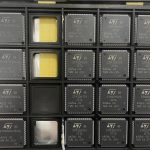
The STM32H723ZET6 is a high-performance Arm® Cortex®-M7 microcontroller launched by STMicroelectronics, belonging to the STM32H7 series. Here is a description of its core functions:
1. Core Features
• Processor:
◦ Arm Cortex-M7 core with a main frequency of up to 550 MHz, supporting the double-precision floating-point unit (FPU) and the DSP instruction set, suitable for high-performance real-time computing.
◦ It supports the ART Accelerator™ (Adaptive Real-Time Accelerator), enabling zero-wait state execution.
• Memory:
◦ Flash: 512 KB (including ECC error correction)
◦ SRAM: 1 MB (including 192 KB TCM RAM and 864 KB main SRAM, with hardware parity support).
◦ External memory interface (supporting SDRAM, NOR/NAND Flash, Quad-SPI).
• Power Management:
◦ Operating voltage: 1.62V to 3.6V
◦ Multiple low-power modes (sleep, stop, standby), with support for dynamic voltage regulation.
2. Peripherals and Interfaces
• High-speed Communication Interfaces:
◦ USB 2.0: Supports OTG (Full Speed/High Speed), Host/Device modes.
◦ Ethernet: 10/100 Mbps MAC (external PHY required).
◦ CAN FD: 2 controllers (compatible with CAN 2.0B).
◦ SPI/I2C/UART: Multiple channels, supporting high-speed modes (for example, SPI can reach up to 150 MHz).
◦ SDMMC: Supports SD/eMMC cards.
• Analog Peripherals:
◦ ADC: 3 16-bit SAR ADCs (with a sampling rate of up to 4 Msps).
◦ DAC: 2 12-bit DACs.
◦ Comparators, temperature sensors.
• Timers and PWM:
◦ Advanced timers (suitable for motor control), general-purpose timers, low-power timers.
◦ High-resolution PWM (< 200 ps resolution).
• Graphics and Display:
◦ Supports the LCD-TFT controller (with graphics acceleration).
◦ Hardware JPEG codec.
3. Security and Reliability
• Hardware Encryption:
◦ AES, SHA, RSA accelerators, supporting True Random Number Generator (TRNG).
◦ Secure Boot and storage protection (OTP area).
• Protection Mechanisms:
◦ Memory ECC, write protection, voltage monitoring (BOR/PVD).
4. Package and Pins
• Package: LQFP144 (20×20 mm)
• GPIO: Up to 114 I/O ports, supporting 5V tolerance.
5. Typical Application Scenarios
• Industrial control (PLC, HMI)
• High-end consumer electronics (drones, AR/VR)
• Medical devices, audio processing
• IoT gateways, edge computing
6. Development Support
• IDE: STM32CubeIDE, Keil, IAR
• Ecological Tools: STM32CubeMX (pin configuration), HAL/LL libraries
• Debugging Interface: SWD/JTAG, Trace function (external probe required).
7. Key Advantages
• High main frequency + large memory, suitable for complex algorithms (such as machine learning inference).
• Rich integration of peripherals, reducing the cost of external components.
• Hardware-level security features, meeting the security requirements of the Internet of Things.