
Keywords: Artificial Intelligence (AI); Global Competition; Data Management
Artificial intelligence is profoundly transforming the global economy, military, and daily life, and has become a core arena of competition among nations worldwide. Technologically, algorithms are continuously updated, data is increasingly integrated, and computing power is evolving toward greater environmental friendliness and efficiency. Countries differ in their development approaches: China leverages policy-industry coordination to expand AI accessibility and actively participates in global AI rule-making; the U.S. maintains its lead through major tech corporations while imposing technological restrictions on China; the EU prioritizes AI ethics and safety via the AI Act, yet lags in technological innovation; Japan, South Korea, Singapore, and other nations are pursuing development paths tailored to their respective strengths. Clear future trends emerge: alongside technological blockades, technology sharing persists; AI governance will grow increasingly fragmented; large models will make AI more “intelligent”; and “AI + all industries” will drive profound shifts in the global economic and industrial landscape.

I. Artificial Intelligence Has Become a Core Force Reshaping Global Competition
As a transformative, general-purpose, and integrative key technology, AI is rapidly integrating into the global economic, social, military, and technological systems. It is not only restructuring traditional industrial chains and production models but also driving systemic changes in national security, scientific research paradigms, and social governance.
(1) Driving Industrial Chain Development and Transforming Production, Business, and Consumption Models
AI serves as a convergence of technologies such as the Internet, big data, and cloud computing. By redefining production logics across finance, manufacturing, transportation, and other sectors, it scales up foundational industries like chips and computing power, emerging as a linchpin for reshaping global economic structures and competitive landscapes.
On the production side, AI reallocates production resources through data, algorithms, and computing power. China’s core AI industries recorded growth rates of 33.3%, 18%, and 13.9% over the past three years, helping enterprises reduce digital transformation costs. On the consumption side, AI has spawned new models such as personalized customization and remote services, boosting domestic demand. Over the past decade, China’s digital economy expanded from 11.2 trillion yuan to 53.9 trillion yuan, contributing 66.5% to consumption upgrading and becoming a new engine for stable economic growth. As an industrial chain leader, AI exerts a comprehensive economic impact, driving related sectors like intelligent manufacturing and smart logistics to a scale exceeding 10 trillion yuan.
(2) Integrating into Daily Life and Enhancing Social Governance
AI helps address complex challenges in social governance and deeply penetrates livelihood sectors, reshaping interactions between people and social services/governance.
In public administration, AI has been deployed in education, healthcare, transportation, and other infrastructure, improving governmental governance capacity and service efficiency. According to the 2022 UN E-Government Survey, over 80 countries use AI for policy simulation and risk early warning. In daily life, AI-powered devices permeate shopping, dining, travel, healthcare, and other scenarios. By analyzing personalized needs and delivering intelligent recommendations, they enable “one-click operation” and “one-tap realization,” greatly enhancing convenience.
(3) Revolutionizing Warfare and Giving Rise to the “Human Decision-Making, AI Execution” Model
AI processes battlefield data 22 times faster than humans, transforming military decision-making and combat modes. It is a critical technology for achieving “preemptive decision-making, long-range strike, and breakthrough of operational constraints” in future warfare. China’s “Intelligent Blue Force” system showcased in the 2025 Zhurihe Exercise learned from data from over 200 global wars, simulated 17 typical tactics of the U.S., Russian, and other militaries, optimized drone swarm flight routes in real time, and predicted command decisions.
The “human decision-making, AI execution” combat model is now applied in precision strikes, unmanned vehicle assaults, electronic warfare control, and other key domains. A 2023 report by the Stockholm International Peace Research Institute (SIPRI) notes that over 35 countries are researching military applications of AI, marking the global military transformation’s entry into an intelligence-led phase.
(4) Transforming R&D Models and Fostering “AI + Industry” Synergy
Intelligent models such as DeepSeek and ChatGPT drive technological breakthroughs to a qualitative leap via the “data-algorithm-feedback” cycle. For instance, AlphaFold2 resolved the 3D structures of 230 million proteins in just 18 months—600 times faster than traditional experimental methods.
Open-source technologies are booming, with global AI code open-sourcing growing at 40% annually, significantly boosting basic research and technology application efficiency. Meanwhile, AI integrates into all links of enterprise production, enhancing production and transaction efficiency. However, rising costs and uneven distribution constrain model performance improvement and in-depth industry application.
II. Current Global AI Landscape and Future Trends
Global AI is at a critical juncture where institutional restructuring and technological advancement proceed in tandem, with stark divergences in national strategic planning, institutional design, and technological pathways. On one side stands the U.S.-led technological blockade and rule-binding; on the other, China advocates technological equity and open cooperation. The global AI landscape is shaped by ongoing tensions between “suppression” and “sharing.” In governance, “AI for Good” (benefiting humanity) has become a global consensus, yet institutional frameworks grow increasingly fragmented, intensifying rule competition. Technologically, large models centered on the Transformer architecture are becoming the foundation of general AI, while “small models + specific tasks + physical interaction” emerges as a key direction for AI’s scenario integration.
(1) Coexistence of Technological Suppression and Technological Equity: A “Tech Cold War”
AI development is deeply intertwined with national strategy, geopolitics, and global industry. Future progress will not only involve improvements in model capabilities, computing power, and scenario applications but also hinge on frontier technologies like large models raising global AI competition thresholds and reshaping the global AI landscape.
On one hand, a small number of tech powers led by the U.S., in alliance with domestic tech giants, leverage advantages in high-quality data, high-performance computing, and advanced algorithms. Through measures such as the CHIPS and Science Act, they restrict exports of high-end GPUs and core technologies. The EU, Japan, and others are pursuing technological localization and exporting their own standards to reduce external dependence and expand influence, constructing a global competitive system of “security reviews, standard restrictions, and bloc alignment.”
On the other hand, China advocates “technological equity,” actively engaging in AI cooperation with Global South countries. By sharing large models, co-building computing power hubs, and jointly establishing laboratories, it helps developing nations enhance AI capabilities, narrow gaps, and expand AI accessibility. These two contrasting approaches—”blockade” versus “support”—have created a new global AI development pattern of “parallel competition between technological suppression and technological equity”.
(2) Fragmented Governance Systems and Intensifying Rule Competition
Rapid AI development has deepened the link between technology and institutions, driving global AI governance toward multipolarity and fragmentation. Incomplete statistics show that over the past decade, countries and regional organizations have issued more than 3,000 AI governance-related documents, resulting in a situation of “abundant regulations but scarce consensus.”
Nations have built governance frameworks with vastly different philosophies based on their political systems, development stages, and technological pathways. Given AI’s involvement in ethics, accountability, culture, and other factors, institutional arrangements vary across privacy protection, data sovereignty, algorithm transparency, and other areas. Establishing unified global AI rules faces enormous challenges, and global AI governance will trend toward “fragmentation” and “rule competition”.
(3) “AI for Good” as a Global Consensus
AI governance is shifting from “passive risk response” to “proactive development regulation,” with “technology for good” (ensuring AI benefits humanity and avoids abuse) becoming an inevitable trend. As large models and generative AI become more prevalent, issues such as privacy breaches, algorithmic bias, and content security have drawn global attention, fueling growing demand for institutional norms governing AI ethics and safety.
(4) Large Models Drive AI to Become More “Intelligent” with Rapidly Improving General Capabilities
Large models built on the Transformer architecture are gradually becoming the foundation of Artificial General Intelligence (AGI), driving breakthroughs and integration in AI’s language, vision, speech, motion, and other multimodal capabilities. In recent years, leading global enterprises and research institutions have invested tens of billions of dollars, propelling large models to achieve leaps in parameter scale, training data, and task adaptability.
Models such as OpenAI’s GPT-4, Anthropic’s Claude, and DeepSeek’s DeepSeek-R1 already possess preliminary general capabilities including cross-task adaptation, contextual understanding, and complex logical reasoning. AI’s general capabilities are poised for exponential growth in the future.
(5) Small Models Integrate into Specific Scenarios, with “AI +” Reshaping Industries and the Economic Landscape
As AI penetrates more scenarios, “small models + specific tasks + physical interaction” has become a key future development direction. Specialized AI focuses on specific domains and tasks, with clear application boundaries and high-quality industry data, outperforming humans in localized capabilities such as facial recognition and gait analysis—already deployed in public security law enforcement and emergency rescue.
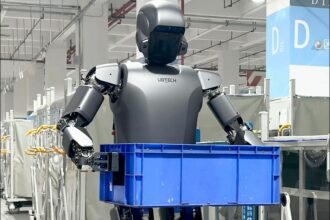
AI’s physical interaction capabilities are also advancing. Humanoid robots, autonomous driving, smart factories, and other applications achieve autonomous decision-making and environmental adaptation via multi-sensor perception and reinforcement learning, significantly improving operational consistency and reliability. Intelligent systems characterized by “human-machine collaboration, autonomous learning, and continuous evolution” are rapidly developing. AI is entering a closed-loop stage of “perception-thinking-decision-execution,” and by around 2035, it is expected to profoundly transform technological models and operational mechanisms in key sectors such as education and healthcare.